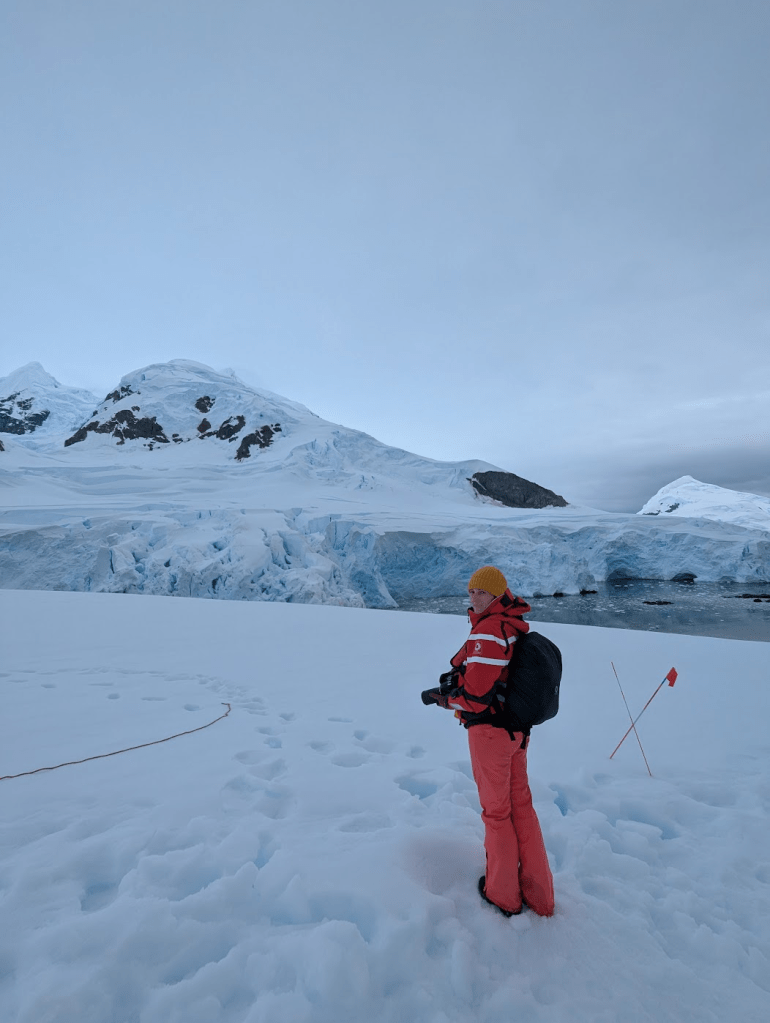
You are small, the world is bigger
(And that’s beautiful)
I don’t remember the cold:
I know it was cold
– it’s Antarctica-
But I don’t remember noticing it.
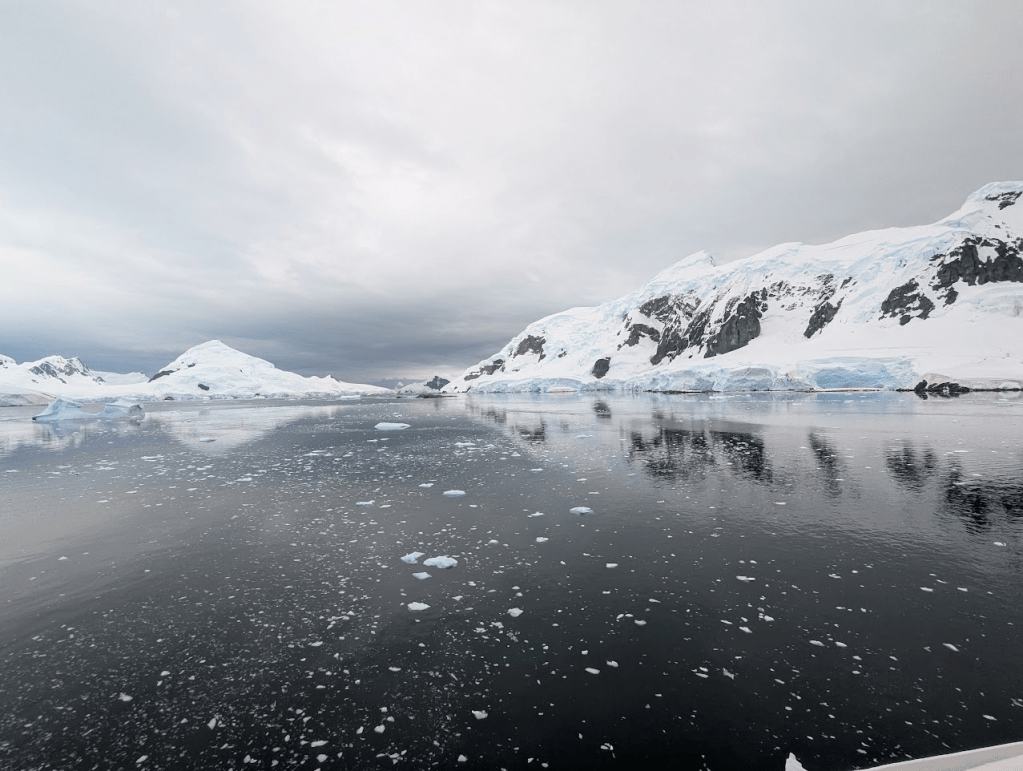
The water is calm and dark. Icebergs dot the sea like the stars dot the night sky. There’s a strange peace and sense of comfort from the sea, just something, being, and being what it’s meant to be.
So, this is Antarctica.
Everything is big. We are small.
I’ll never be an astronaut, but I imagine the feeling of stepping off your travel vessel for the first time is the same: for me, it’s stepping into an unknown place; for an astronaut, it’s stepping into the unknown universe.
An entirely new place that, for the first time, you’re truly immersed in. Years of preparation and planning went into the making of this moment, the last few seconds moving in slow motion: the tucking of your suit into your big, tall boots. Next, it’s the layers of lifesaving gear, the safety checks, and the anticipation bubbling in your stomach as the door of the ship opens, and you’re craving to catch a small glimpse of the world you’re about to explore.
That first step, when your foot is hovering between the safety of the door and the uncharted outside, is a choice. And while an astronaut’s step launches them into space, where footprints go rogue, my step leads me to a new planet, an alien world.
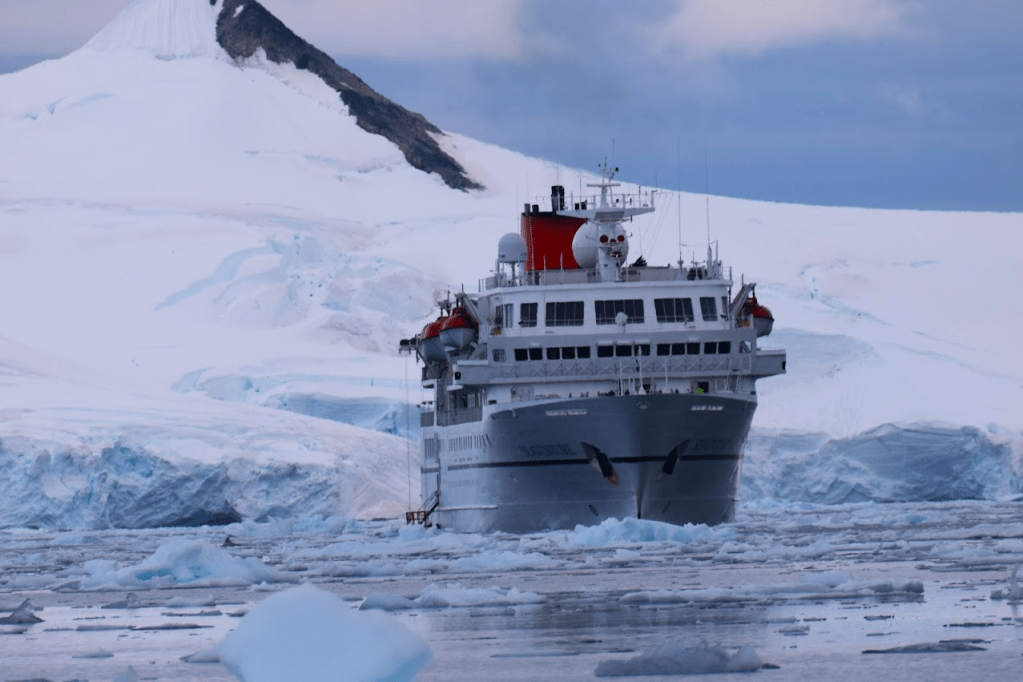
I wonder if an astronaut gets a pit in their stomach without gravity. I can promise the swooping in my stomach was only amplified with every shrinking inch between us and the ship’s door. We’ve learned to love the ship- and the home within it. But we didn’t spend over 500 days saving, long days of work, months in the making, just for a boat ride. For us, it’s not about the journey; it’s literally about the destination.
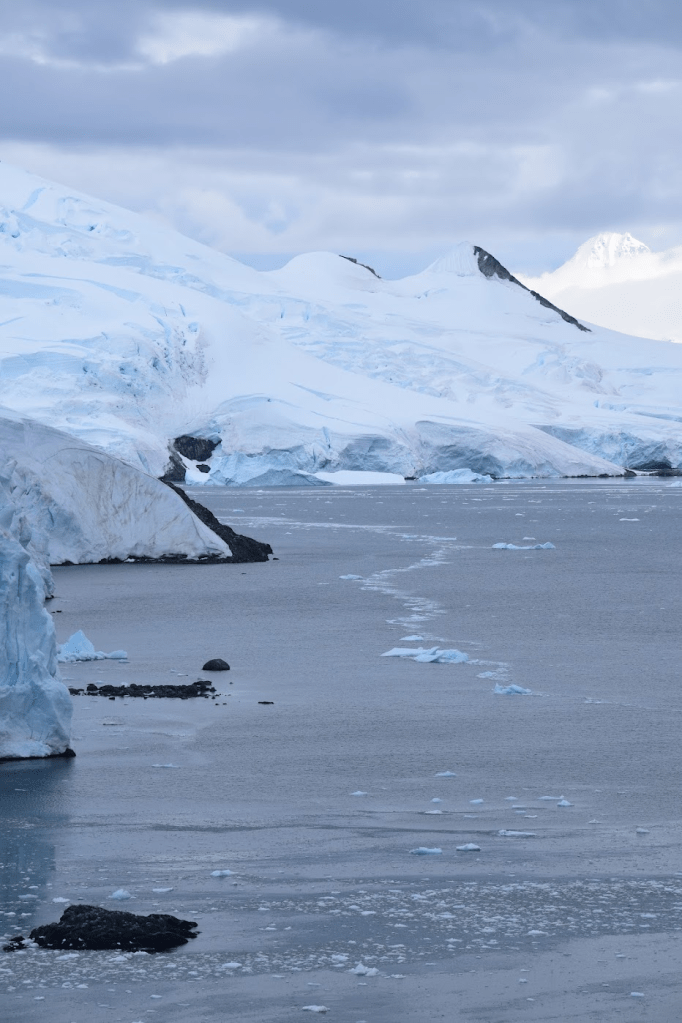
We venture out. And are instantly overshadowed by the steep face of towering, bold, glacier-covered mountains and cliffs.
Slowly, the understanding settles in:
Everything is overwhelmed by the simple fact that every single thing in your vicinity, the foreign world you’re discovering, has only been seen by a very small percentage of the homo sapian species. Where few have ventured before. A land that can count you among the first thousands to be there.
I do remember the wind; it stung my cheeks. But they were so warm and red from the budding excitement, the laughter and buildup, for the awe of the self-proclaimed “coolest-badass-thing-I ’ve-ever-done!” that the wind couldn’t cool my warm heart.
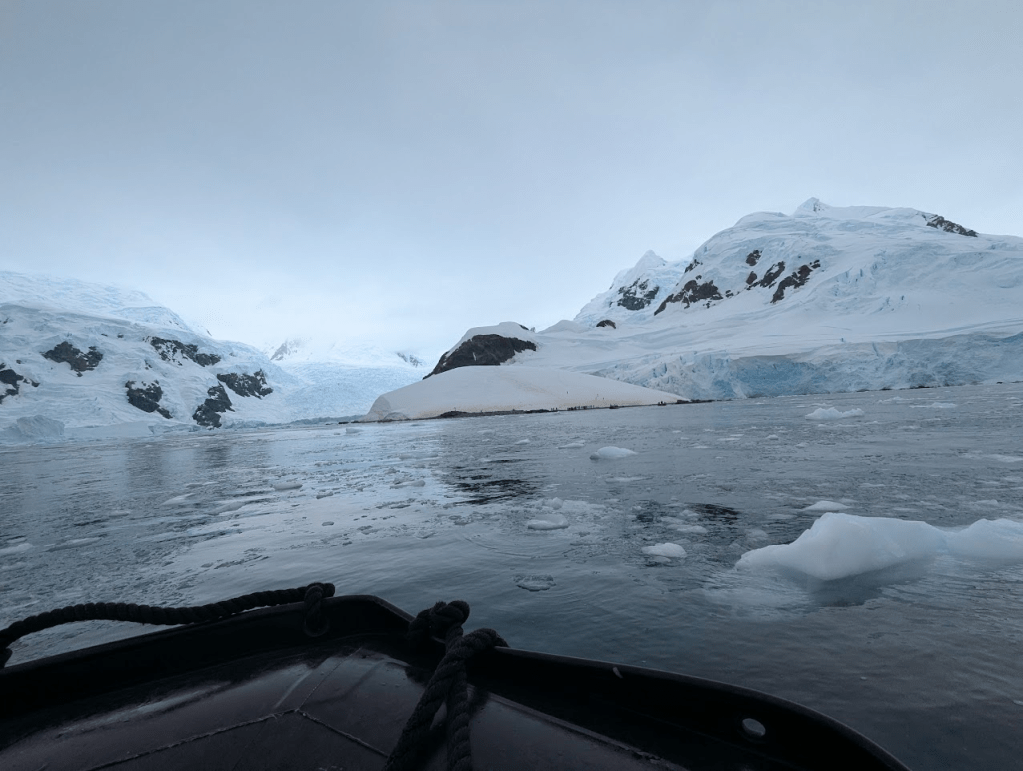
I remember the wobble of the Zodiac boat when I stepped into it, and the sailor’s grip from the guide helping me down. It felt like the world had paused. It was calm on the water and calm in the sky. I was not calm. My hands curled. Clutched around a precious, beloved camera like it’s a lifesaving parachute on a mayday plane. Having no idea what was going to occur next. Anticipating excitement. A homo sapian, wading into the land of ice.
There is a simplicity in the title “homo sapian” :
And thus sparked my realization that we are not special. We are alive, we move, we build, we create, we feel- and so does nearly every form of life we know of. The birds, the whales, the coyotes, the flowers- we are not alone in the universe, much less on this planet.
We’re not a special species. We’re a dominant, rapidly evolving species. Some say we’re “sentient,” “developed,” and even “superior” to other forms of life. I’d argue we separate our understanding of life into categories: “lesser than” being anything that doesn’t look like us, have what we have, or survive like we do. Anything that isn’t human doesn’t follow the steps our species took in evolution (“lesser than”). Perhaps more interestingly, I wonder whether a species following the steps we took would evolve the same way we did. Or, if we’d consider them as equals. Perhaps by then, we’d consider each other equals.
This realization comes in an unpredictable second. Hits me like a snowball to the face. I’m sitting in our small boat. I feel free of ego’s disappointment, balanced, and content in my role. A part of a sum. Realizing this, broke down a wall between the continent and me. It shattered to reveal a deeper level of beauty, suddenly, stinging, and thriving. Just like the land of the ice, vast before me.
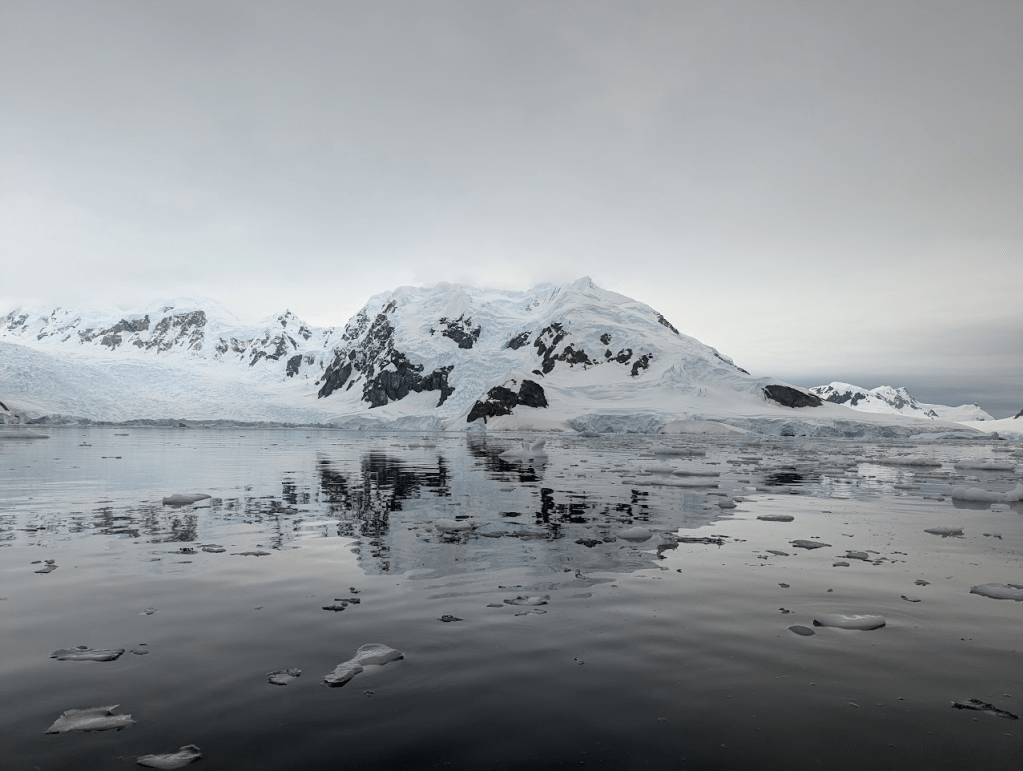
We’re in Paradise,
Paradise Harbor, that is, on the western coast of the Antarctic Peninsula. Eons ago, the land beneath us was South America, and the mountains were the extending tendrils of the Andes. Upon Antarctica’s split from South America, the Western Peninsula became a glacial mountain range, one of many found on Antarctica. However, the various Antarctic mountains are very different from their cousins that dot the globe.
I don’t remember being surprised that Antarctica’s Peninsula was extremely mountainous. I thought nothing of it. I saw the mountains and gaped and awed, but I wasn’t surprised. Perhaps because I grew up in the mountains, trekking over ridges and valleys, lost in snowstorms. The mountains are familiar to me; I’m used to seeing them.
Later, our Expedition Guide Leader, Laura, would share her first memory of Antarctica itself, and her surprise at the mountains, their dramatic ledges and ice-torn slopes. Her surprise made me notice that I’d hadn’t shared it. And then, it planted a new idea in my mind. An idea that would simmer and grow, one day developing into this story you read now: Perhaps there are so many ways to see the world that some you can only experience through others.
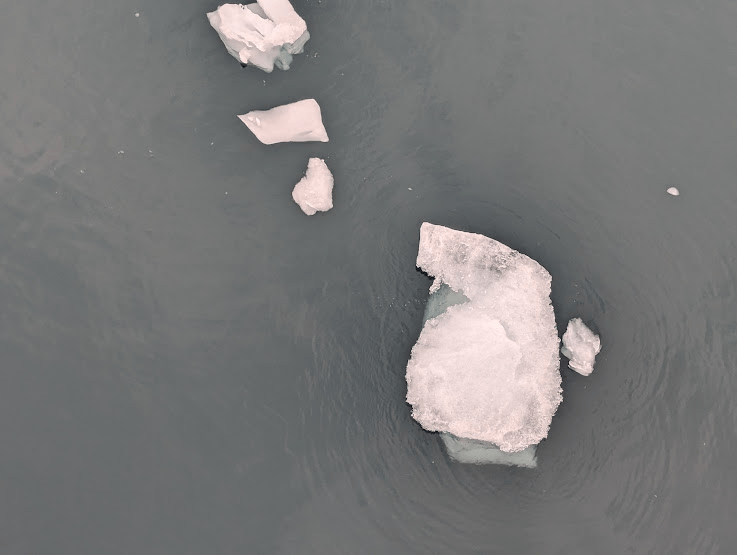
Antarctica’s Challenge:
Antarctica’s climate requires adaptation from all species that survive there. The continent is a Polar Desert, the driest, windiest, coldest, iceist and highest average elevation landmass in our known universe. It challenges every form of life, sapping energy, demanding sacrifice, and taxing with extinction-grade weather.
The scars of these battles litter the environment. There are gouges carved out of mountains where enormous glaciers once proudly grew. Stubborn snow that’s faced enough polar-night blizzards and is now too proud to let the sun wear it completely down in the summer. Vicious, silent predators lurk beneath the surface, invisible and waiting to strike down their prey. Blinding, deafening, and numbing, the environment takes a toll on our fragile senses. But on day one of exploring the continent, we don’t care. Damn the consequences, wouldn’t you agree?
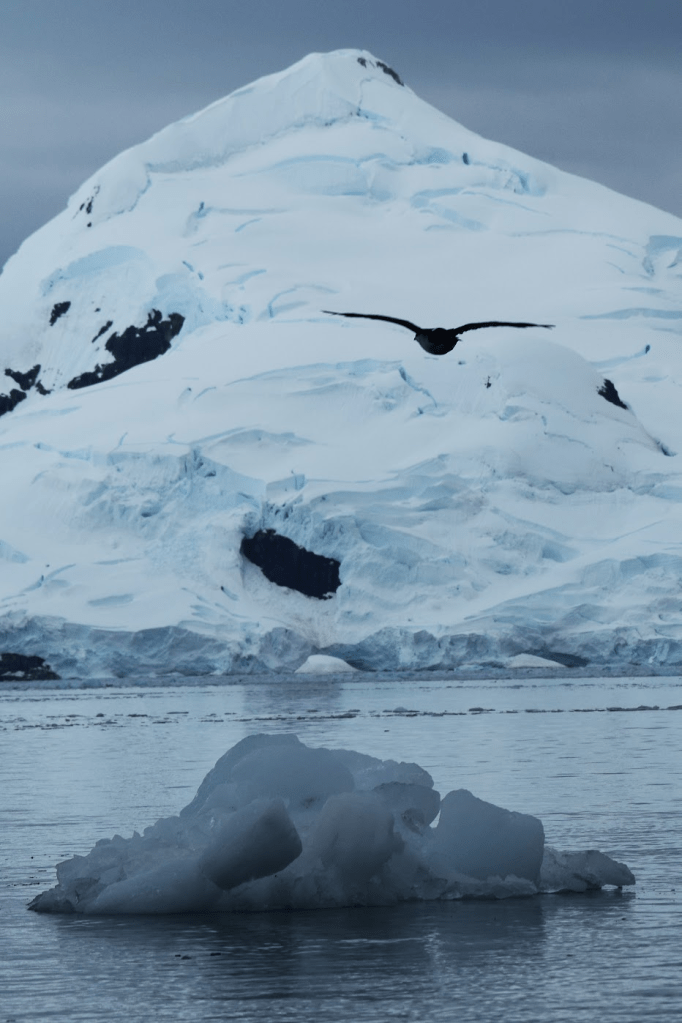
As we begin our Zodiac cruise into the corners, nooks, and crannies of the harbor shelters, the weight of Antarctica’s challenge hits hard. It echoes in the back of your mind, freezing your fear. But fear has no use here. It’s too overwhelming, and if you’re too afraid of the world, you’ll never truly engage with it. That won’t work in this neck of the woods. You must master the environment, be tough and critical, look past appearances, and trust your gut, your judgment, and science’s guidance on this inescapable terrain.
But learning about a biome this intricate and diverse is so, so, very difficult. (Look, I’m sorry, what I remember of my science education consisted of sheep heart dissection (like, three times?), Bill Nye, and an egg drop challenge I won by shoving a raw egg into a jar of peanut butter. Take your concerns up with the American public school system, not me.)
Antarctica taught me that every biological and physical aspect of our Earth is combined. They are all related and influential on one another. Balanced on the base of the world, Antarctica’s waters and skies have hosted every drop of precipitation on Earth. Animals that, months before, were in the Caribbean waters, spend chilly summers in the icy seas and harbors, eating. Their main food source is an Antarctic species. Nothing is alone in this world of supposed isolation.
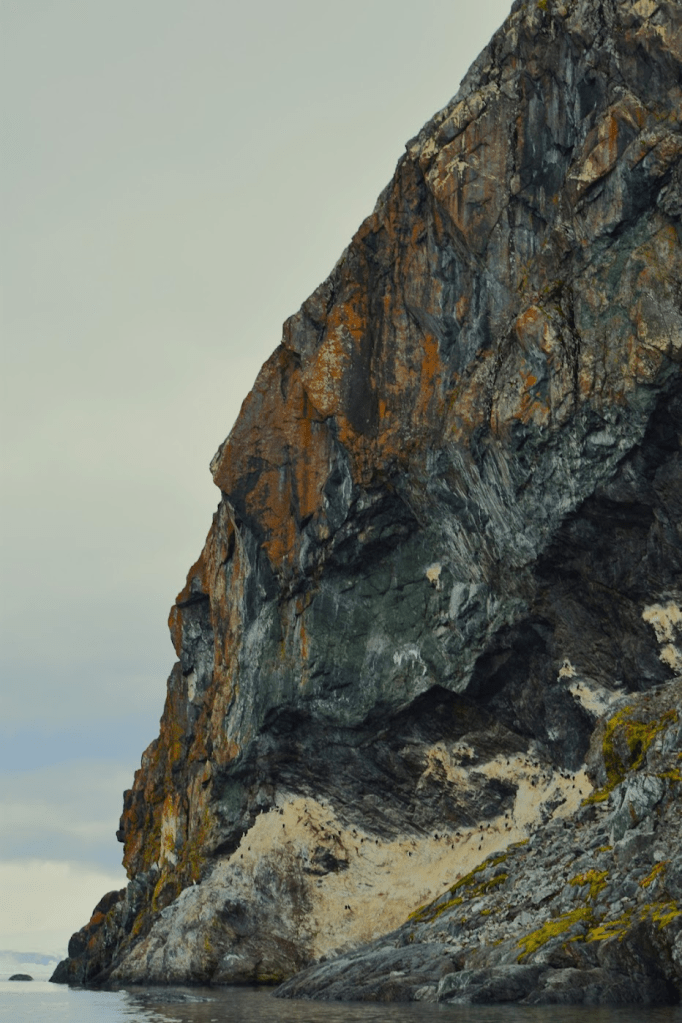
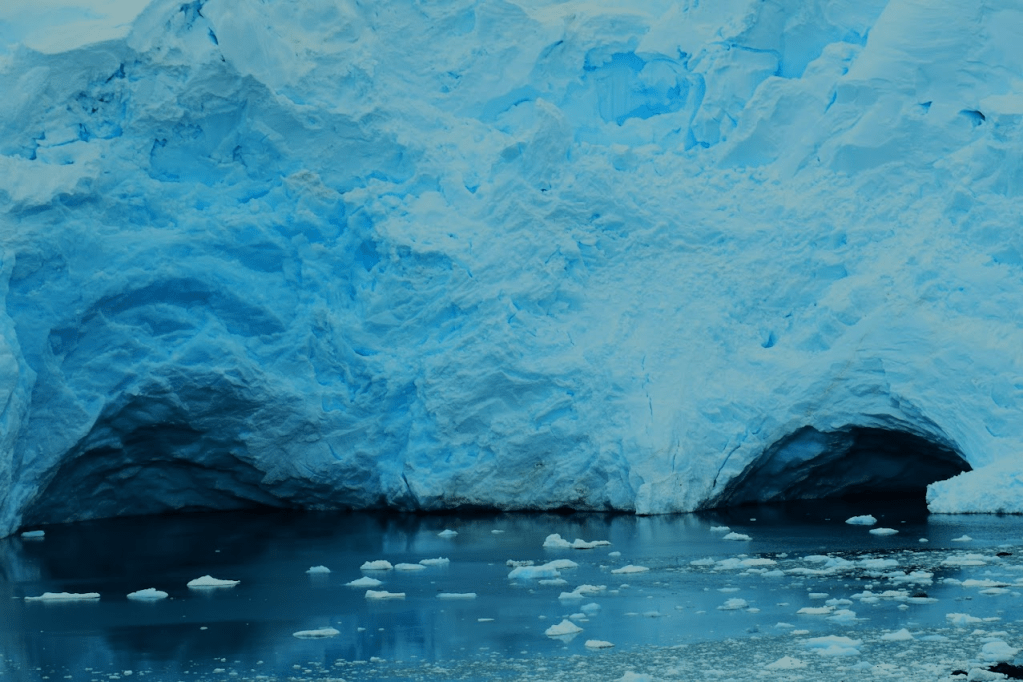
Far braver people than I have dared to overwinter in the total darkness and through the unquenchable storms. For me, there is not enough Sunny D in the world to get me through that debilitating darkness. One version of Antarctica’s challenge, and one I wouldn’t be up to.
So instead, our Antarctic challenge is that of a protector. Whatever conquests we try to claim on the land, they pale in comparison to the deeply intricate ecosystem that’s survived for thousands of years. It was undisturbed and independent, reliable like clockwork. Impervious to humanity’s greed and destruction, this land sees “conquest” lying not in power and rule, but in balance and codependency.
We’re participants in the continent’s conservation. Our respect, attention, and give-a-sh*t quantities are the next steps. On our voyage, we follow biosecurity protocols, regularly disinfect, and adhere to all rules and expectations developed to keep the land, the animals, and the invasive visitors (us) safe. Boots clean, eyes open and up, with your ego abandoned; that’s how we set off in this lawless place.
Everything comes in shades of greyscale I never even knew existed. From the sea, the ice, the reflections, the sky, and the 20-hour daylight that blends and refracts light into thousands of variations, it is all new. I know I saw countless colors for the first time, in every second of the day. Seabirds are soaring, dipping, turning, dancing through the sky. When the sun peeks out, it is like a young child, afraid but curious. And just a hint of that life-bringing light illuminates the snowglobe around us. With the gold of the sun, the quiet of the raw world, and the snow’s call for attention. My mind, completely overwhelmed by the world in front of me, shuts off.
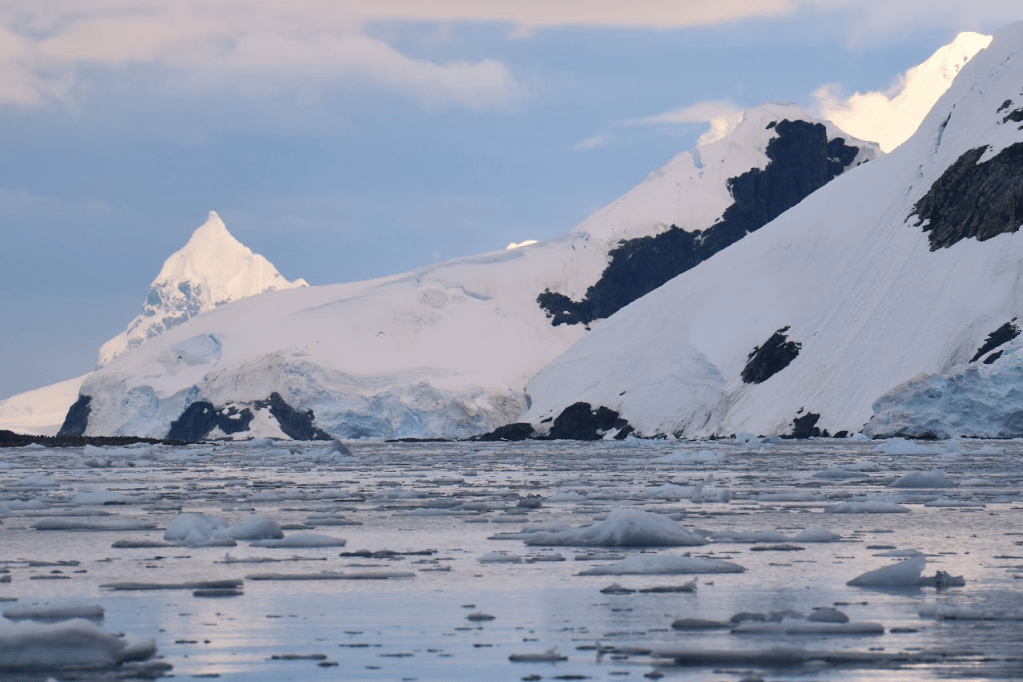
Memories foggier than the clouds, but more real than the wind:
Looking back, I don’t have vivid memories of our harbor explorations. I remember glimpses of Southern Humpback Whales blowing oxegyn up to 10 feet high, flashes of birds zooming through the air. I remember the Crabeater Seal well, the misleadingly lazy animal snoozing on an iceberg. But even that I remember, admittedly, because my brain attached it to the fact that Crabeater Seals don’t actually eat crabs… and a part of me found that really amusing, hence the lasting memory.
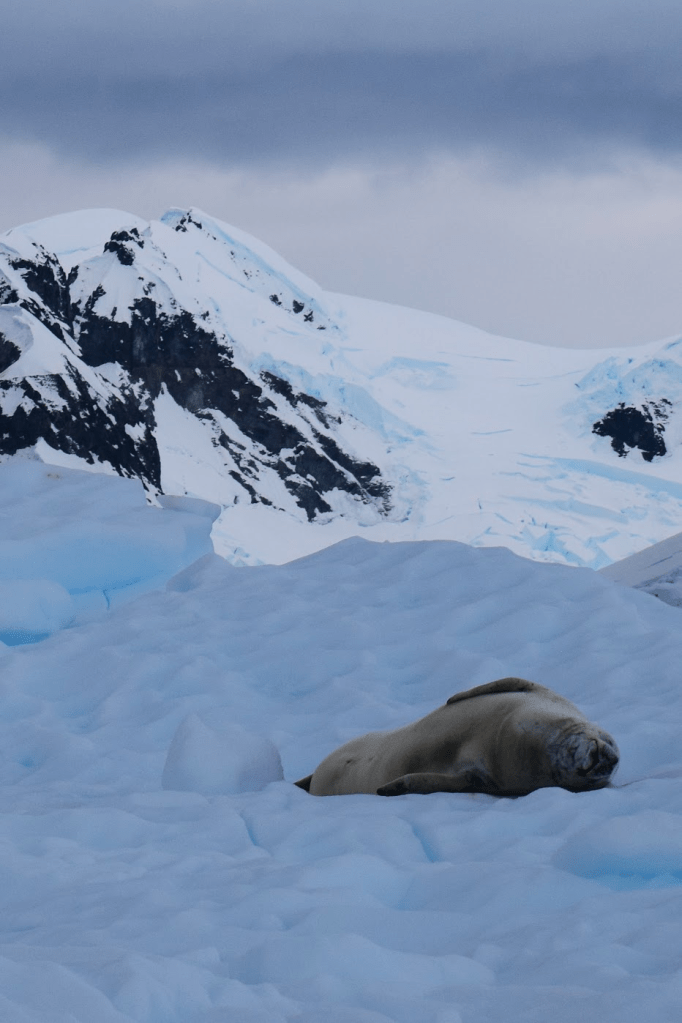
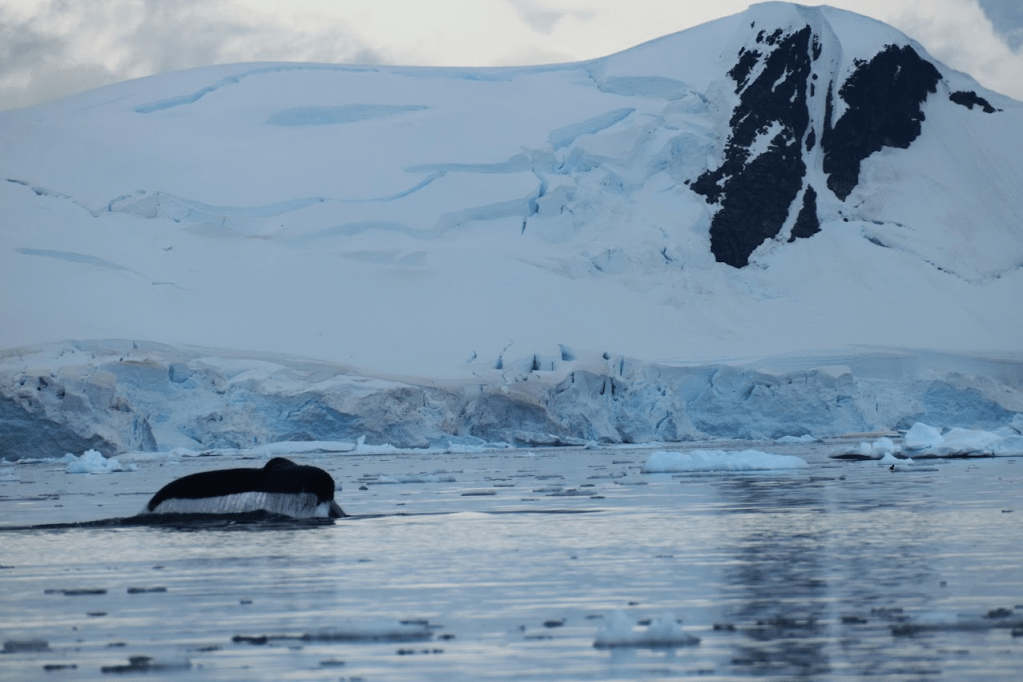
My pictures hint at other moments in the water, tantalizing snapshots of the memories that lived only in those moments. Massive forms and beings in front of me, 1,000x bigger than myself, and 10,000x smaller than the whole they form part of. Things this big are hard to trap. They’re too encompassing, filled with too much change. It’s an overload of information and active senses, tense on the edge of the experience. I’m only 5’2”, far too small to be able to take the entirety of those glacial mountains with me. Instead, I treasure and collect every small fragment in my mind. Snapshots, framed and displayed like puzzle pieces, the holes representing not loss, but highlights. Pieces of history-making.
I think it’s safe to say I’ll never leave a footprint on the moon, and I have no way of knowing what was spiraling through Armstrong’s mind as his foot hovered between the safety of the rocket and the unexplored expanse before him. I know the world likes to remember that first step and the monumental FIRST it achieves. When my foot was hovering between worlds, I thought of that “first.” I’d later realize it wasn’t the FIRST that made history, it was the steps that came after.
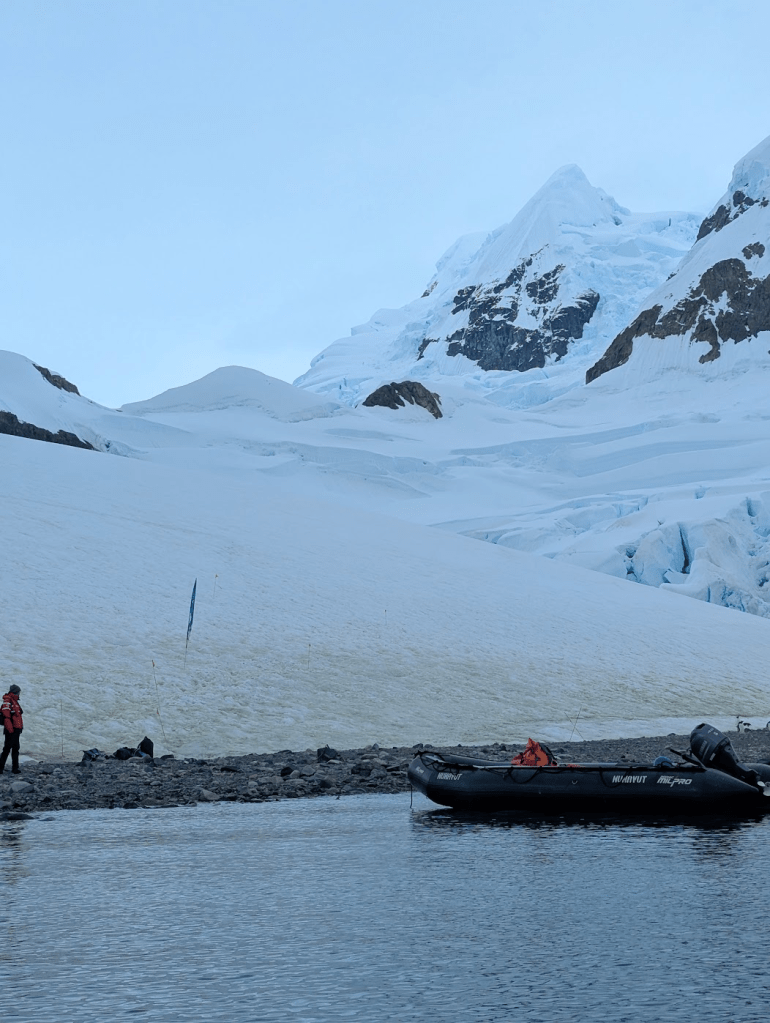
Here’s what I do remember: Clear as ice
I remember the crunch of the pebble beach under Laura’s boots as she directed our boat up to the Antarctic shore. I remember laughing in wonder.
‘Look! There’s the penguins!’
Was the first thing I heard on my sixth contintent, courtesoy of my good friend, and travel buddy, Erin.
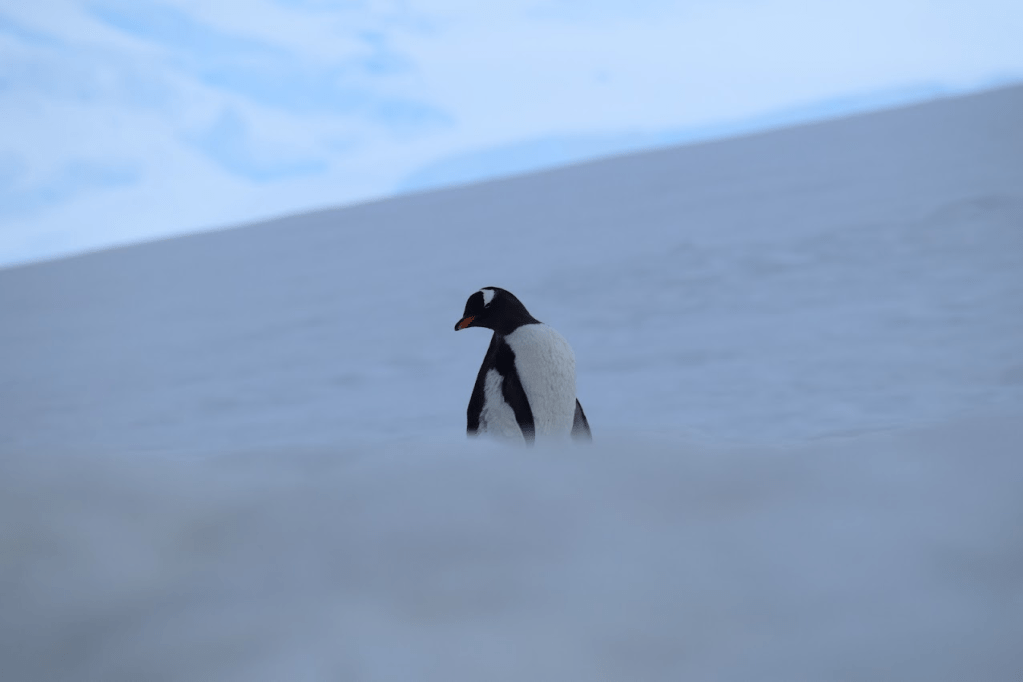
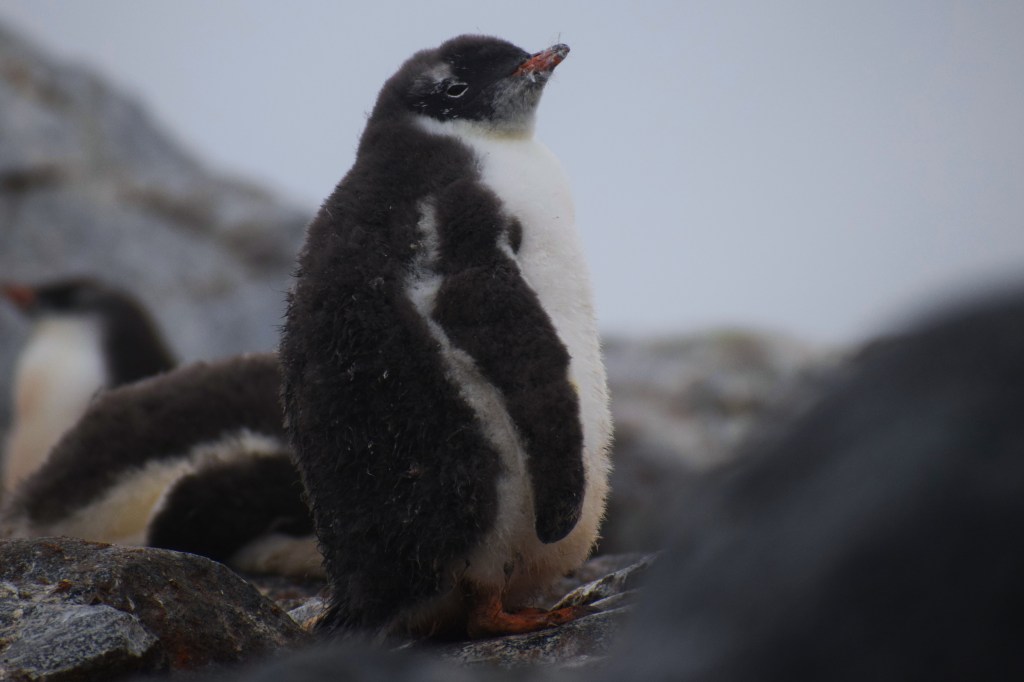
Sure enough, 10 feet from our boat, small Gentoo penguins are waddling up and down the beach. Behind them, a snow hill crest is smooth, uninterrupted except for the single-file trail stamped out by human feet that disappears up and over the hill. The base of it is just twenty feet in front of us.
*Splash*
……. Pause ……
*Crunch*
That’s what it sounded like in the moments it took for me to step onto Antarctica.
I don’t remember the cold.
I do remember the squawking penguins around us, the vastness of the sky, and the clouds blanketing the world. I remember looking down at my boots, just checking this was real. I remember the round, smooth, salty pebbles that made the beach, the big wet rocks, and the mist from the sea. I can still hear the small waves from the Antarctic Ocean rolling in, and I watch the pebble rocks turn into varying shades of dark blue, green, navy, and greenish grey.
Looking back, I wonder. I’d be surprised if, despite Armstrong’s fame for his first step, he was so overwhelmed by it that he didn’t take a second. And a third. I just don’t believe the first footprint was all he cared about. Was all he wanted to achieve. He’s the first to walk on the moon, not just to touch it. Perhaps he was looking up and away from his footprint. Looking across the great vast abyss. The moon’s first visitor. I imagine his eyes craving to see it all up close. Feeling too small to take it all in at once. I dream he just wanted to see how far he could go and find out how many things he could see. Is the urge to do so strong enough that he considers just running? And bouncing? Leaping across the surface? Wanting to play in low gravity. To laugh in wonder at the cosmos. I refuse to believe the ‘FIRST’ step was more important than all that follows. So, I think what follows should be celebrated instead. Everything you learned, saw, and experienced, rather than everything it took to get there.
If I were him, I’d prefer a title not about the “first” to step, walk, or land on the moon, but rather something like this:
Neil Armstrong: “First To Explore the Moon and First to Attempt a Cartwheel in Space”
Anika Kieler: ‘Story collector of the Ice World.’
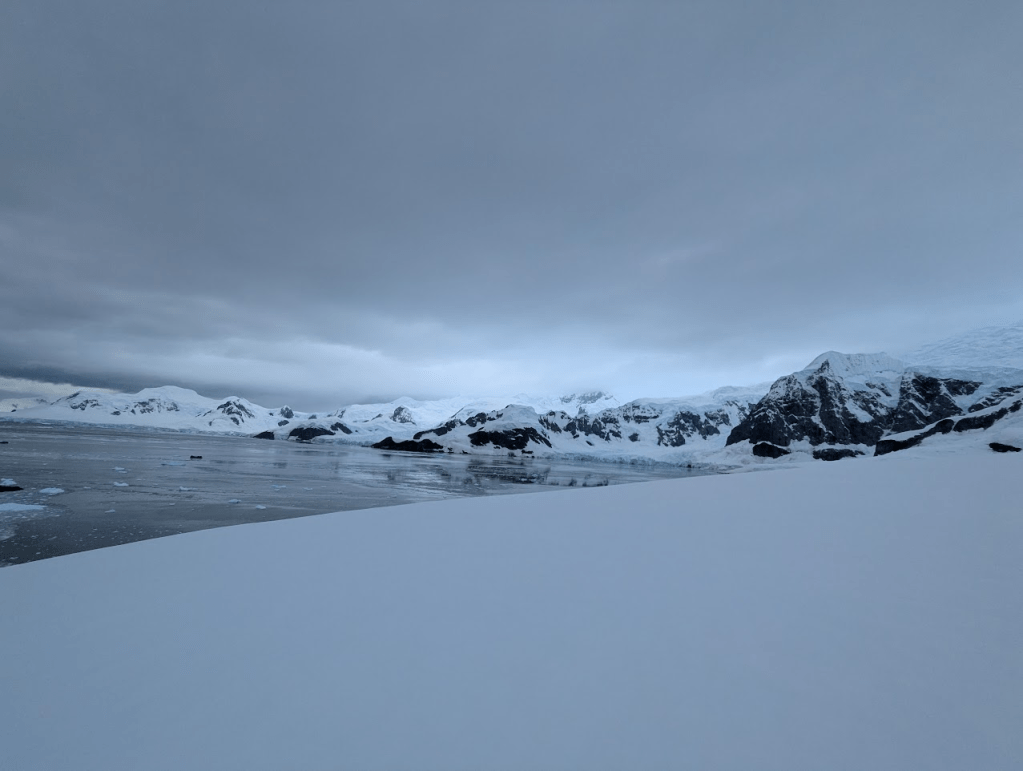
Lured by the curve of the hill and the clouds beginning to part, we were giddy walking toward the trail that led away from the beach. It’s slushy and warm as we walk. The snow’s dissolving under our feet. We’re soon irritated by the effort of carrying gear up the trail, sweating in the layers we wear. Staggering in the snow. Out of breath, breathing deeply. Slightly annoyed at Antarctica for being hilly. But, unequivocally in awe. No rush, no worry, no fear. Just euphoria and compounding curiosity.
Despite our efforts on the hike, the end of the trail reminds us how small we are. That was my first thought. We may be on top of the hill, overlooking the whole bay. But we’re also losing sight of the ship we thought was massive. There it goes, blurring between the icebergs and the clouds. We’re so small. And it is so incredibly beautiful.
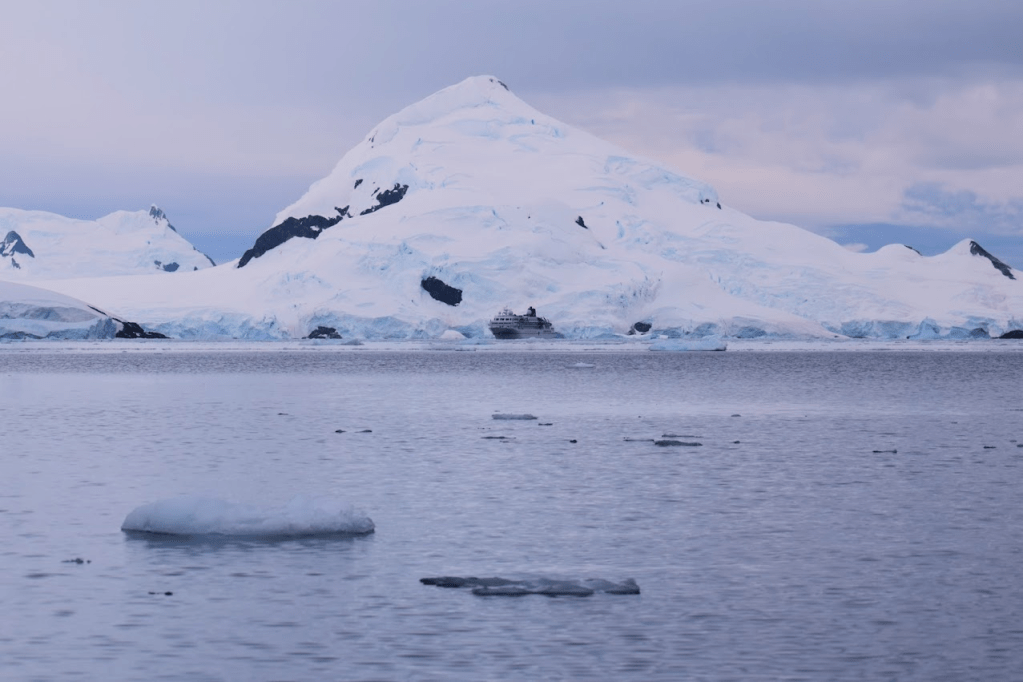
Small:
Even the birds, from the tiniest Snow Petrel to the largest Albatross, serve only as reminders of our place. They dominate the skies, voyage through the winds. Even the penguins, at just two feet tall, are experts in this terrain, at home on both land and in the sea. They’re fearless on the beach, unstoppable. They may waddle, but they move quick. We dodge them like land mines, desperately trying to keep to the Ecotourism Rules’ mandatory distance between you and wildlife. Even quicker in the water, penguins swim like a bullet shooting through the icy sea.
Towering above us are mountains stacked upon more mountains. Jagged layers of ice, snow, and rock hang over us unshakable, bold, and steady. The laborious climb up proves our perceptions are changing. The so-called “hike” wasn’t really significant. At least not in the face of, or comparison to, the astronomically large ridges above us.
And if all of that isn’t enough to put us in our place, we were about to be given one final, massive demonstration. Perhaps fittingly, it started when we were looking the wrong way. We were looking out across the ocean and the bay, not toward the land.
Suddenly, the rumble of glacial change sends shockwaves out and then a sky-splitting CRACK!!!
Deafening, thunderous… cripplingly powerful, the glacier calving behind us numbs my nervous system. My hair stands on end, and I feel the shake in my fingertips. We turn, only to see the last of the once-solid mountain collapsing into the ocean, dissolving like cotton candy in the water.
Glaciers are massive, immovable chunks of ice and snow, brutally resilient, locked in for centuries. And yet… we watch it die. In seconds. And then it’s gone. The entire wall. Alcatraz has splintered, Fort Knox has fallen, and the Pentagon lies bare.
It’s unusually still and quiet. The world seems to pause. Then the sea foam starts to settle. The birds start to fly again. But we are still stuck. We saw a grand cathedral of ice, arched and freestanding, disintegrating faster than a rising tide swallows a sandcastle.
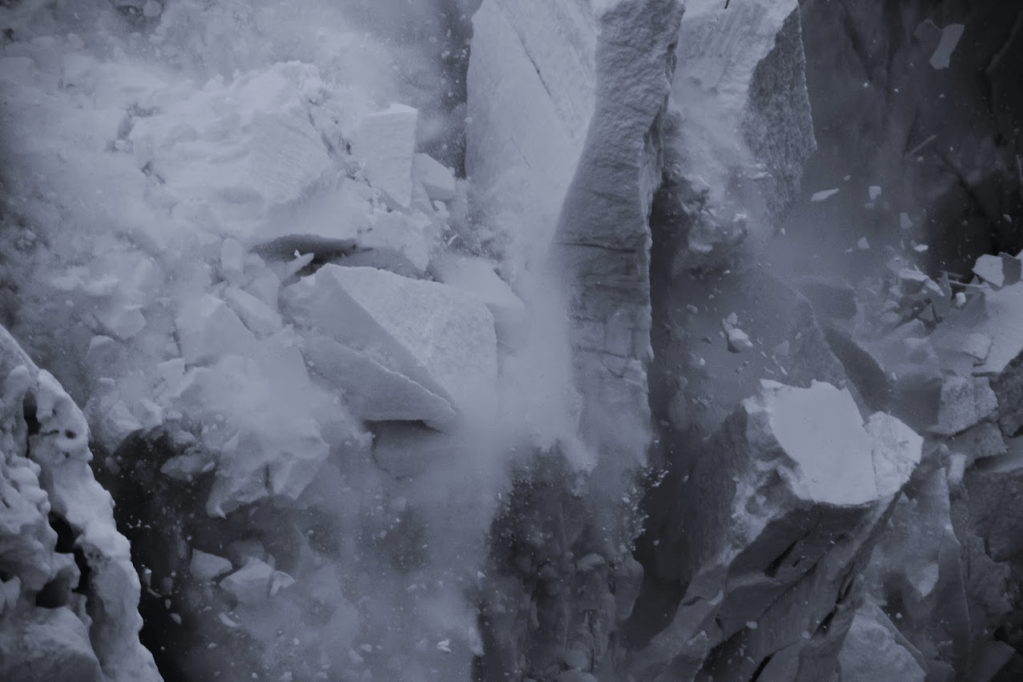
It’s the kind of event that would obliterate Colorado’s mountain communities. The kind of noise that would make you question the stability of the tectonic plates beneath your feet. Thousands of variations of frozen water -there are literally thousands of variations of ice- that once stood tall now don’t. Once a beacon, a silhouette in the sky. Now it’s just a memory.
The aftershock ripples race out into the bay, the stilled water set in motion. Waves sent so far, and with so much strength, our ice-class specialty-built Antarctic ship shakes and rolls where it rests out in the middle of the bay.
And then there’s just what’s left behind. What didn’t crumble. We now know its apparent stability is deceiving. The settled, frozen ice could collapse again at any moment. They say a healthy fear turns into a healthy respect.
I have a healthy respect for glaciers now.
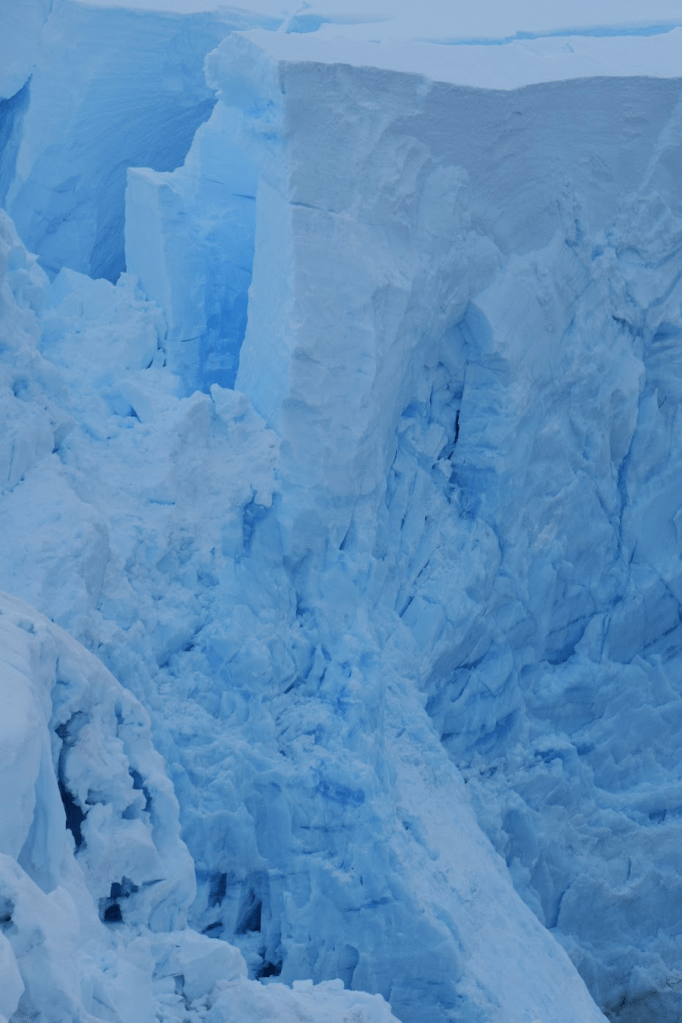
The glacier’s calving has everyone, even our seasoned expedition team, in awe. Starstruck. But the event that’s literally rocked our world has no effect on anything else here. It draws no reaction from anything in the bay, but us.
This calving is just one of hundreds. In every canyon in every bay of every coast of Antarctica, every single day of the year, this happens. We saw one example of a frozen monument’s collapse, but it’s only one of millions.
I can imagine the event from the other side, not human but an Antarctic species. I wonder if it’s similar to what happens when a siren drives by your window. Humans are used to the noise of emergency vehicles. We only pause in conversation just long enough to let the brief interruption pass. Perhaps the penguins do something similar. A troubling, life-changing noise that can mean the difference between life and death. And it’s ignored and forgotten within a minute.
You certainly can’t experience something like that on the moon, Niel.
But we are not native to this place. And it is not an emergency siren- it’s the premature, human-aided collapse of a continent. Like watching Stonehenge topple. Just a casual destruction of a one-of-a-kind masterpiece. The kind that takes its centuries-old secrets to the grave.
I don’t remember the cold, but I do remember the stark silence.
The silence in the land and the sea. The whole world was silent. Silent in memory of the end of millennia. Silent after seeing a fractured piece of the world disappear forever.
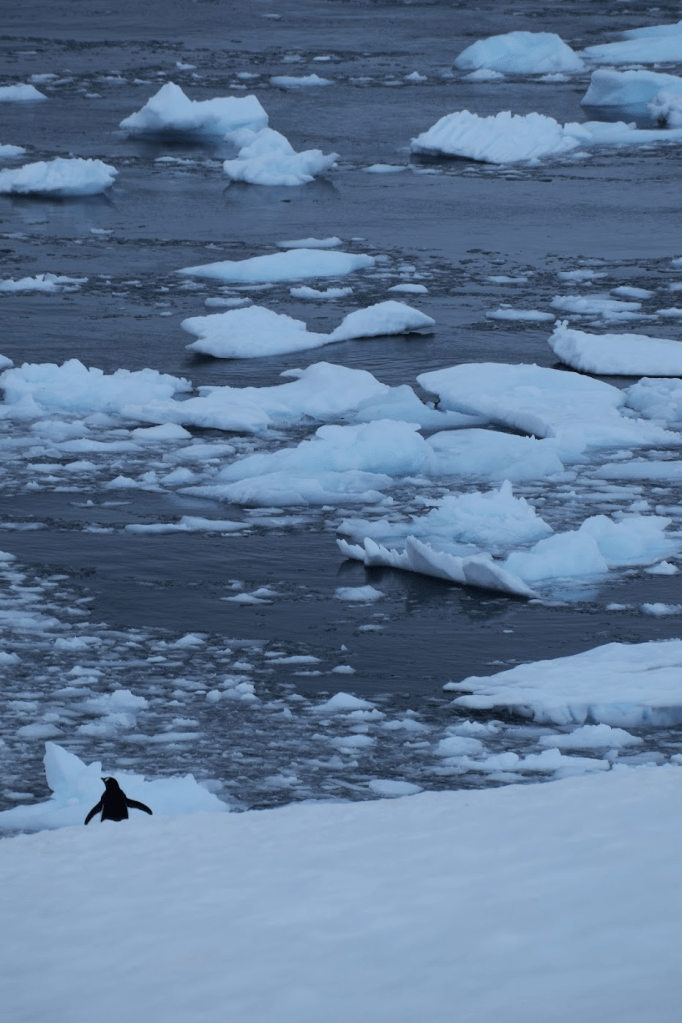
A legacy doesn’t end with collapse; it begins:
Like the Roman Empire, or Brittany Spears. Collapse strengthens a legacy. It turns tragedy and dramatic change into dried ink on the pages of iconic history.
‘There are so many ways to see the world, and some you can only experience through others’ recollections,’ I wrote earlier…
If only we could ask a glacier what it’s seen. Let us in on what the oxygen trapped inside it from 100,000 years ago has to say about what that world was like. If only we could converse with the whales and hear the sounds of music, waves riding on the ocean’s waves, songs reaching you, teaching you, even when you’re isolated. I wish I could swim with the seals, as they dive and dance with balletic precision. Please let me ride on the wings of the invincible albatross and live on the world’s wind highways.
I still don’t remember the cold.
I remember the wind, the vastness. I remember the striking, open sky, stretching across miles of uninterrupted horizon.
I remember the crack of the glacier and the salt on the breeze that flavored my lips. I remember I tried to capture as many moments as I could. But I just couldn’t keep up. Too much, too special, so big, vast and overwhelming…
So small in the world. A dot in the ocean, a microbe-sized cell in a global ecosystem.
I sat with that, and slowly, over many an hour, contemplated my thoughts over the railing of the starboard side deck walk. I found peace in the understanding of smallness (although I’ve always been made fun of for being short, so I was a little used to it).
You just can’t carry everything with you. A glacier holds millions of years of stories and secrets, trapped in time. But even they cave. And we’re far too small for a fraction of that capacity. We can hold a couple of stories. We can collect them in an anthology, perhaps. But we are, and always will be, insignificant in the face of a glacier. Even if we one day kill it, warming the ocean, leaking its frozen fresh water into the sea, we will never match the legacy it carries.
I wish I could share every second of my adventure. I wish you could feel the sting of the wind on your cheeks or the sharpness of a deep breath breathed in from frozen air. I wish that as you read these words, if you’ve managed to come to them, you find some reflection of yourself. Some peace in my story. Some space away from the world you’re actually in.
This is a remote, myth-like part of our world, and it is beautiful. It is so big, so powerful and vast, and we are so small.
However, I can say with absolute certainty that I have never been a better citizen of this world, never been a better cog in my community, and never been as engaged in our ecosystems as I am now.
From here, I’m not sure what to do next, or where I’ll end up. But, if I’ve learned anything in Antarctica, it is how alive the continent truly is. Armed with a new definition of resilience, an understanding of the interconnectedness and value of biology and ecology, and fully broke but addicted to travel, I will fill up my life with experiences and knowledge. And extra coats.
Because if a penguin can survive the ‘hell-hath-frozen-over’ seasons, so can you.
Anika Kieler, April 2026